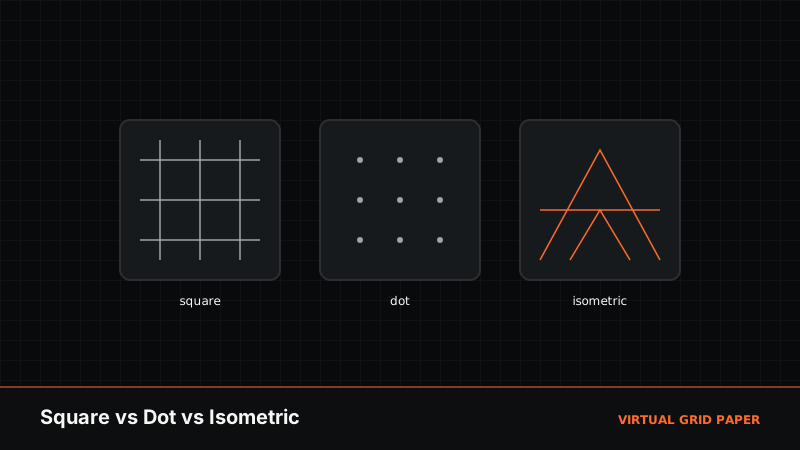
Not all graph paper is the same, and choosing the wrong grid can make a task harder than it needs to be. Square grids, dot grids, and isometric grids each guide your pen in a different way — one is built for coordinates, one for clean notes, and one for 3D form. Knowing which does what saves time and produces better results.
This comparison breaks down square, dot, and isometric graph paper: how each grid works, its strengths and weaknesses, and the tasks it suits. When you have decided, you can generate any of them on the printable graph paper generator.
Key Takeaways
- Square grid — full lines; best for math, plotting, and precise alignment.
- Dot grid — intersection dots only; best for clean notes and sketching.
- Isometric grid — 60° triangular grid; best for 3D and technical drawing.
- All three are available to generate and print online for free.
Table of Contents
- Square Graph Paper
- Dot Grid Paper
- Isometric Graph Paper
- Side-by-Side Comparison
- How to Choose
- Frequently Asked Questions
1. Square Graph Paper
Square (quadrille) paper is the grid most people picture: evenly spaced horizontal and vertical lines forming a lattice of squares. The full lines give strong visual guidance — you can count units in any direction and read positions at a glance.
Strengths: precise alignment, easy unit counting, ideal for coordinate plotting and equations. Weaknesses: the dense lines can feel busy and can compete with your own marks. Best for: math homework, coordinate geometry, graphs, engineering computation, and any task where you measure along the grid.
The international school standard is a 5 mm square; the US often uses quarter-inch. Either is a click away in the generator.
2. Dot Grid Paper
Dot grid keeps only the intersections — a matrix of light dots instead of full lines. You get the same positional guidance, but the page stays clean and your content dominates rather than the grid.
Strengths: minimal visual clutter, flexible, looks tidy; equally supports text, sketches, and tables. Weaknesses: slightly less precise for reading exact positions than full lines. Best for: bullet journaling, note-taking, UI wireframes, hand-lettering layouts, and loose diagrams.
Dot grid has become the default for planners and journals precisely because it guides without dominating. For most notebook work a 5 mm dot spacing hits the sweet spot — close enough to align text and small sketches, open enough to stay out of the way. Drop to 3–4 mm only if you write small; go to 7–8 mm for large handwriting or quick diagrams.
3. Isometric Graph Paper
Isometric paper replaces the square lattice with a triangular grid of lines at 60°, creating a surface built for drawing in three dimensions. Along its three axes, you can render boxes, mechanical parts, and environments with consistent proportions.
Strengths: makes 3D drawing intuitive; keeps depth and scale consistent. Weaknesses: not suited to standard 2D graphing or coordinate work. Best for: product and industrial design, mechanical sketches, architecture, and game/tile art. Our isometric graph paper guide covers technique in depth.
Generate any of these styles
Open the printable graph paper generator →4. Side-by-Side Comparison
| Feature | Square | Dot | Isometric |
|---|---|---|---|
| Grid marks | Full lines | Dots only | 60° triangular lines |
| Visual weight | Heavier | Light | Medium |
| Precision | Highest | Good | 3D-oriented |
| Coordinate plotting | Excellent | Good | Poor |
| 3D drawing | Poor | Poor | Excellent |
| Journaling / notes | Fair | Excellent | Poor |
| Typical spacing | 5 mm / ¼ in | 5 mm | 5 mm triangles |
5. How to Choose
Ask what you are doing:
- Measuring or plotting? Square grid.
- Writing, planning, or sketching cleanly? Dot grid.
- Drawing something three-dimensional? Isometric.
If you regularly switch between tasks, generate one of each and keep them handy. And if your needs go beyond these three, the A4 graph paper generator adds millimeter, engineering, hexagonal, polar, and logarithmic grids. For a broader survey of grid families, see square, triangular, isometric, and perspective grids.
Common Mistakes
- Using dot grid for precise coordinate work, where full lines read faster.
- Forcing square grid for 3D sketches instead of isometric.
- Ignoring density — the right style at the wrong spacing still frustrates. See choosing grid density.
When Each Style Wins
Square is the all-rounder for anything mathematical or measured. Dot is the modern favorite for journals, planners, and clean layouts. Isometric is the specialist for three-dimensional work. None is “best” overall — the best grid is the one matched to the task in front of you.
Related Tools and Guides
- How to use isometric graph paper
- How to choose the right grid density
- Grid paper sizes and types
- Create printable graph paper online
Conclusion
Square, dot, and isometric graph paper solve different problems: precise measurement, clean note-taking, and three-dimensional drawing respectively. Match the grid to your task and the work flows more easily. Whichever you choose, you can generate and print it online for free — and switch styles whenever the task changes.
Frequently Asked Questions
What is the main difference between square and dot grid paper?
Square grid uses full horizontal and vertical lines, giving strong alignment cues for math and plotting. Dot grid marks only the intersections, offering the same guidance with a cleaner, less busy page that suits journaling and sketching.
When should I use isometric graph paper?
Use isometric paper for 3D drawings, technical and mechanical sketches, product design, and game tiles. Its 60-degree triangular grid makes it easy to draw three-dimensional forms with consistent proportions.
Is dot grid or square grid better for math?
Square grid is generally better for math and coordinate plotting because the full lines help you count units and read positions. Dot grid works well for looser notes and diagrams where a cleaner page is preferred.
Can I generate all three styles online?
Yes. The printable graph paper generator and the A4 graph paper tool both offer square, dot, and isometric styles, which you can customize and download or print for free.