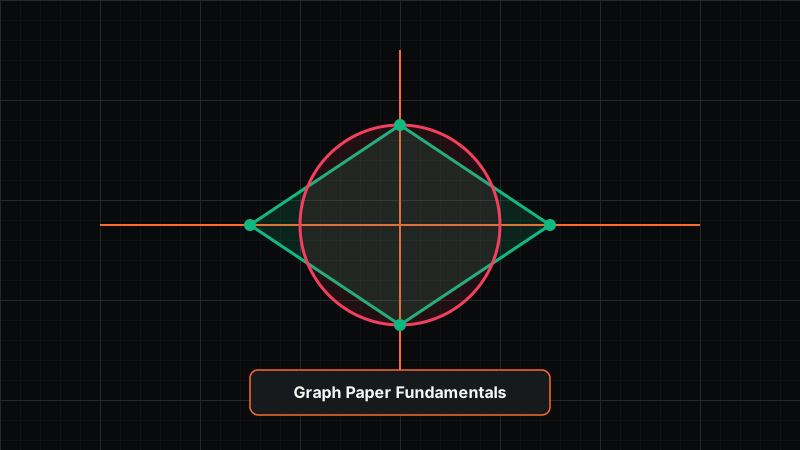
Graph paper—also known as grid paper, coordinate paper, or quadrille paper—is a specialized writing surface printed with fine horizontal and vertical lines that intersect to form a continuous grid of equal squares.
Unlike standard lined notebook paper, which only guides vertical line spacing for handwriting, graph paper provides a full two-dimensional coordinate plane. This structural framework makes it essential for mathematics, geometry, scientific data plotting, engineering drafting, architectural layouts, and digital illustration.
Key Takeaways & Quick Overview
- Grid Line Hierarchy: Combines light minor grid lines (1 mm or 5 mm spacing) with darker major accent lines (every 5th or 10th square).
- Primary Uses: Algebra plotting, geometry proofs, physics lab data, engineering schematics, and architectural floor plans.
- Standard Sizes: International 5 mm quadrille A4 sheets and North American 1/4-inch quad sheets.
- Digital Workspaces: Web tools eliminate paper eraser smudges and offer point-to-point grid snapping with instant vector PDF exports.
Table of Contents
- How the Graph Paper Grid Works: Line Hierarchy
- Common Graph Paper Grid Types and Sizes
- Key Practical Uses Across Fields
- History and Evolution of Graph Paper
- Printable Graph Paper vs. Digital Graph Paper
- Frequently Asked Questions
1. How the Graph Paper Grid Works: Line Hierarchy
High-quality graph paper relies on a clear visual hierarchy of line weights to keep drawings organized and readable.
+-----------------------------------------------------------------------+
|  Graph Paper Line Hierarchy Example (5 mm grid with 5x major accent)  |
|                                                                       |
|  |----|----|----|----|====|----|----|----|----|====|                 |
|  1    2    3    4    5 cm  6    7    8    9   10 cm                 |
|  (Light 0.15mm minor lines)  (Thick 0.30mm major accent lines)        |
+-----------------------------------------------------------------------+
Minor Grid Lines
Minor grid lines are fine, light background lines that define individual cell boundaries—such as 1 mm, 5 mm, or 1/4-inch squares. They are intentionally kept at low opacity (often soft blue, green, or light gray) so they do not overpower pencil sketches or mathematical notation.
Major Grid Lines
Major grid lines appear at regular intervals—typically every 5th or 10th minor line. Printed with heavier line weights, major lines divide the page into prominent 1 cm or 1-inch blocks. This enables students and engineers to scan large coordinate offsets instantly without counting tiny individual grid squares one by one.
2. Common Graph Paper Grid Types and Sizes
Different technical disciplines require specific grid configurations:
| Grid Type | Cell Dimensions | Line Weight & Style | Best Applications |
|---|---|---|---|
| 5 mm Quadrille | 5.0 mm × 5.0 mm | Orthogonal 90° squares | School math, algebra homework, geometry |
| 1 mm Millimetric | 1.0 mm × 1.0 mm | Fine grid with 5/10mm accents | Physics labs, calculus graphs, optics |
| 1/4 Inch (4x4) | 0.25 in × 0.25 in | Imperial Quad grid | Standard North American school math |
| Isometric Grid | 60° Triangular grid | Diagonal 3D construction lines | Engineering 3D sketches, piping, isometric CAD |
| Dot Grid | 5 mm dot spacing | Subtle dot intersections | Bullet journaling, UI wireframing, sketching |
To understand how physical paper formats like A4 and US Letter constrain printable grid areas, read our guide on standard graph paper sizes and A4 graph paper dimensions.
3. Key Practical Uses Across Fields
Graph paper is far more than a simple drawing sheet; it is an active problem-solving canvas across multiple disciplines:
A. Mathematics and Algebra
Graph paper is fundamental for learning algebra and calculus. By assigning horizontal movement to the X-axis and vertical movement to the Y-axis, students plot ordered pairs (x, y), calculate slope (m = Δy / Δx), and trace linear equations such as y = mx + b.
B. Geometry and Spatial Construction
Constructing accurate geometric shapes requires exact side lengths and perpendicular right angles. Graph paper allows users to construct squares, right triangles, regular polygons, and symmetrical curves without ruler slips. Learn step-by-step techniques in our guide to drawing geometric shapes on graph paper.
Try It Online
Want to plot coordinates or draw geometry digitally?
Open Virtual Grid Paper and experiment with the grid directly in your browser—no installation required.
C. Engineering and Technical Drawing
Civil, mechanical, and electrical engineers use graph paper to sketch initial component designs, circuit schematics, and orthographic projections before transferring drawings into CAD software. Discover specialized engineering techniques in our guide on graph paper for engineering and technical drawing.
D. Architectural Floor Plans and Site Layouts
Architects use grid paper as a proportional scale guide. For example, assigning 1 grid cell = 1 foot (or 0.5 meters) enables designers to sketch wall boundaries, door swings, and window openings to scale before drafting detailed floor plans.
E. Crafting, Stitching, and Pixel Art
Beyond science and math, crafters use graph paper grids to design cross-stitch embroidery patterns, beadwork designs, and 8-bit digital pixel graphics, where each square represents a single stitch or color pixel.
4. History and Evolution of Graph Paper
The invention of printed graph paper in the late 18th century transformed mathematics and engineering. Dr. Buxton of England registered one of the earliest patents for coordinate paper in 1794, printing grids for surveying and navigational calculations.
Throughout the 19th and 20th centuries, graph paper became a standard educational tool in schools worldwide, replacing blank slates and unruled paper. Today, modern web applications carry this evolution forward into interactive digital vector canvases.
5. Printable Graph Paper vs. Digital Graph Paper
While physical paper pads have been standard for generations, web-based digital graph paper tools offer modern advantages:
+-----------------------------------+-----------------------------------+
|  Printable Graph Paper            |  Digital Virtual Workspace        |
|                                   |                                   |
|  - Physical paper & pencil        |  - Web browser canvas             |
|  - Permanent lines (eraser smudges) |  - Instant Undo / Redo history    |
|  - Fixed grid spacing per notebook|  - Adjust grid size from 1mm-50mm |
|  - Scanner needed for submission  |  - Direct PDF / SVG vector export |
+-----------------------------------+-----------------------------------+
For a detailed analysis of when physical paper is preferable versus digital software, read our comparison of printable vs. digital graph paper.
Frequently Asked Questions
What is graph paper used for?
Graph paper is used for plotting mathematical functions, drawing geometric figures, drafting engineering schematics, aligning handwritten calculations, and constructing architectural floor plans.
What is the difference between major and minor grid lines?
Minor grid lines form individual small grid squares (e.g., 5 mm), while major grid lines are darker, thicker lines placed at larger intervals (e.g., every 5th or 10th cell) to make coordinate counting fast and accurate.
What is the standard grid size for school graph paper?
The standard school grid size is 5 mm (0.5 cm) quadrille paper internationally, or 1/4-inch (4x4) grid paper in North America.