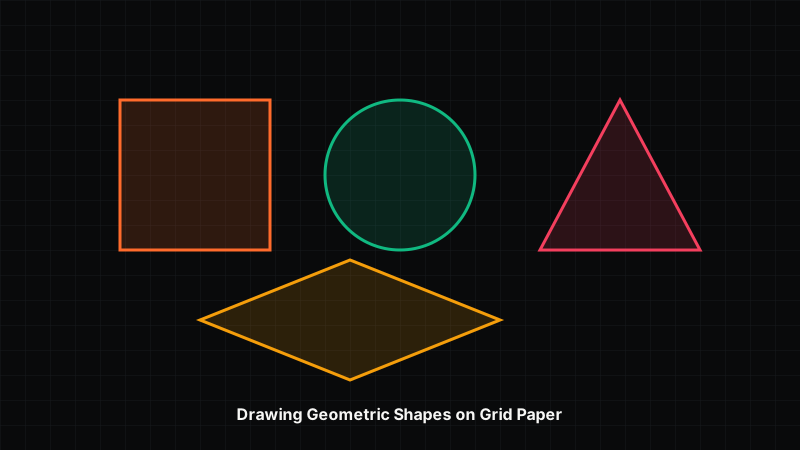
Drawing accurate geometric shapes is a foundational skill in geometry, architecture, engineering, and digital design. While drawing shapes on blank paper often leads to uneven sides and skewed angles, graph paper provides an built-in mathematical framework that guarantees precision.
By using grid intersections as coordinate vertices, you can construct perfectly proportioned squares, rectangles, right triangles, regular polygons, and circles without needing complex drafting tools.
Key Takeaways & Quick Overview
- Rectangles & Squares: Count grid units along horizontal and vertical grid lines for perfect 90° right-angled corners.
- Triangles: Construct right triangles using perpendicular grid legs and calculate hypotenuse length via Pythagorean theorem (a² + b² = c²).
- Circles (Cardinal Anchor Method): Plot 4 cardinal radius points (North, South, East, West) from center (h, k) and 4 diagonal 45° helper points before tracing arcs.
- Interactive Vector Drawing: Web tools auto-snap vertices to exact grid points and calculate area, perimeter, and angles live.
Table of Contents
- Drawing Rectangles and Squares with Grid Precision
- Constructing Triangles: Right, Isosceles, and Equilateral
- Drawing Regular Polygons (Hexagons and Octagons)
- Constructing Circles and Arcs on Graph Paper
- Drawing Shapes Online with Interactive Vector Snapping
- Frequently Asked Questions
1. Drawing Rectangles and Squares with Grid Precision
Squares and rectangles are the simplest figures to construct on graph paper because their sides align directly with horizontal and vertical grid lines.
Constructing a 6x4 Unit Rectangle:
Point A: ( 2, 2 ) ---- [ 6 Grid Units ] ---- Point B: ( 8, 2 )
   |                                             |
[4 Units]                                     [4 Units]
   |                                             |
Point D: ( 2, 6 ) ---- [ 6 Grid Units ] ---- Point C: ( 8, 6 )
Step-by-Step Instructions:
- Choose a Starting Vertex: Mark a point A at any grid intersection.
- Draw the Base: Move horizontally along the grid line by your desired width (e.g., 6 grid units) and mark vertex B.
- Draw the Height: From vertices A and B, move vertically upward along grid lines by your desired height (e.g., 4 grid units) to mark vertices D and C.
- Complete the Shape: Connect vertex D to vertex C along the horizontal grid line.
- Verify: Check that opposite sides are equal (AB = DC = 6, AD = BC = 4) and all internal angles equal 90°.
2. Constructing Triangles: Right, Isosceles, and Equilateral
Triangles require combining straight grid lines with diagonal connections.
A. Right-Angled Triangles
Right triangles leverage perpendicular grid lines:
- Plot the right-angle vertex at a grid intersection (0, 0).
- Extend the horizontal base along the grid line by a units (e.g., 6 units).
- Extend the vertical leg along the perpendicular grid line by b units (e.g., 8 units).
- Draw the hypotenuse connecting the two outer endpoints.
- Apply the Pythagorean theorem (c = √(a² + b²)) to verify that the hypotenuse length equals 10 units.
B. Isosceles Triangles (Symmetrical Alignment)
To draw a perfectly symmetrical isosceles triangle:
- Draw a horizontal base of an even length (e.g., 8 grid units).
- Find the exact midpoint of the base (4 units from either corner).
- Follow the vertical grid line passing through the midpoint upward by your desired height (e.g., 7 units) to place the top apex vertex.
- Connect the apex vertex to both base corners.
3. Drawing Regular Polygons (Hexagons and Octagons)
Regular polygons feature equal side lengths and equal interior angles.
Octagon Grid Construction Shortcut:
1. Draw an 8x8 square box on the grid.
2. Cut 2x2 grid corners diagonally at 45-degree angles.
3. Result: An octagon with equal symmetrical sides.
Drawing a Regular Hexagon:
- Draw a horizontal line segment of length L (e.g., 4 grid units).
- From the center of the line, measure vertically upward and downward by (√3 / 2) · L ≈ 0.866 · L (approx. 3.5 grid units).
- Extend horizontal parallel line segments of length L centered at those heights.
- Connect the outer endpoints to form a 6-sided symmetrical hexagon.
Vector Shape Tools
Want to draw geometric shapes with auto-snapping?
Construct polygons, right triangles, and circles with live HUD readouts in Virtual Grid Paper.
4. Constructing Circles and Arcs on Graph Paper
Drawing smooth circles on a square grid without a compass uses cardinal anchor points:
Circle Construction Anchor Method:
         North ( 0, +R )
            .  |  .
   West     ---+---    East
( -R, 0 )   .  |  .   ( +R, 0 )
         South ( 0, -R )
Steps to Draw a Circle:
- Mark the Center (h, k): Choose a grid intersection as the center point.
- Plot Cardinal Radius Points: From the center, measure outward by radius R (e.g., 5 grid units) in four directions:
- North: (h, k + R)
- South: (h, k - R)
- East: (h + R, k)
- West: (h - R, k)
- Plot Diagonal Helper Points: At 45°, measure approximately 0.707 · R (e.g., for R = 5, measure 3.5 units diagonally).
- Connect Points with Arc Curves: Gently curve your line through all 8 anchor points.
5. Drawing Shapes Online with Interactive Vector Snapping
While manual hand drawings can wobble or drift off grid intersections, using an online graph paper application makes geometric shape creation effortless:
- Automatic Polygon Snapping: Vertices snap instantly to exact integer coordinates.
- Real-Time HUD Measurements: Displays side lengths, perimeter, interior angles, and total surface area live as you draw.
- Perfect Geometric Primitives: Select the Rectangle, Polygon, Circle, or Arc tool to generate vector-clean figures in one drag motion.
For deeper mathematical applications, explore our complete guide on using graph paper for coordinate geometry.
Frequently Asked Questions
How do you draw a perfect square on graph paper?
Count an equal number of grid units (e.g., 6 units) along the horizontal grid line and vertical grid line, connecting the 4 vertices at right angles.
How do you construct a right-angled triangle on grid paper?
Draw a horizontal leg along a grid line and a vertical leg along an intersecting grid line. Connect the two outer endpoints with a diagonal hypotenuse line.
Can you draw accurate circles on graph paper without a compass?
Yes, by establishing a center point (H, K) and plotting cardinal radius points (North, South, East, West) along grid lines, then connecting them with smooth arc curves.