People frequently ask: what is the difference between graph paper and grid paper?
In casual school and office conversations, the terms are used interchangeably. You might hear a teacher ask for “grid paper” or a stationery store label a notebook pad as “graph paper” when referring to the exact same product.
However, in technical drafting, cartography, graphic design, and mathematical publishing, clear structural distinctions exist between graph paper and grid paper.
This guide examines the definitions, visual line weight hierarchies, paper variations, and practical use cases for both paper styles.
Key Takeaways & Quick Overview
- Grid Paper: Features a uniform matrix of light horizontal and vertical lines of equal weight. Best for note-taking, bullet journaling, and UI wireframing.
- Graph Paper: Features a visual hierarchy combining fine minor grid lines with prominent major accent lines (or pre-printed X/Y axes). Best for plotting math data, calculus, and engineering.
- Quadrille Paper: A sub-type of grid paper with 4 × 4 or 5 × 5 squares per inch.
- Digital Flexibility: Web tools allow you to switch between uniform grid and coordinate graph modes dynamically.
Table of Contents
- Core Definitions: Graph Paper vs. Grid Paper
- Head-to-Head Comparison Table
- Detailed Breakdown of Paper Variations
- When to Use Grid Paper vs. Graph Paper
- The Digital Solution: Dynamic Grid Switching
- Frequently Asked Questions
1. Core Definitions: Graph Paper vs. Grid Paper
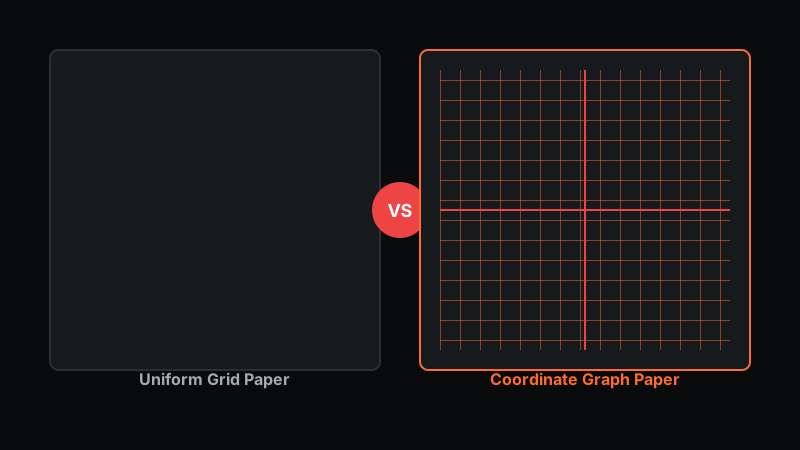
While both paper styles feature intersecting horizontal and vertical lines, their visual organization serves different tasks.
+-----------------------------------+-----------------------------------+
|  Uniform Grid Paper               |  Coordinate Graph Paper           |
|                                   |                                   |
|  .  .  .  .  .  .  .  .  .  .  .  |  |----|----|====|----|----|====|    |
|  .  .  .  .  .  .  .  .  .  .  .  |  (Minor 5mm)   (Major 25mm)       |
|  .  .  .  .  .  .  .  .  .  .  .  |  Includes heavy X/Y coordinate    |
|  (Equal line weights throughout)  |  axes for plotting equations      |
+-----------------------------------+-----------------------------------+
What Is Grid Paper?
Grid paper (or quadrille paper) consists of a uniform matrix of light horizontal and vertical lines forming equal squares or dots. Every grid line shares the exact same line weight and color intensity. There are no heavy accent lines, numbering, or pre-printed Cartesian axes.
What Is Graph Paper?
Graph paper is designed specifically for quantitative data plotting and mathematical modeling. It incorporates a visual hierarchy:
- Minor Grid Lines: Fine, light background lines (e.g., 1 mm or 5 mm spacing).
- Major Grid Lines: Emphasized, darker lines appearing every 5th or 10th cell (e.g., every 10 mm or 1 inch).
- Pre-printed Axes: Some specialized coordinate graph paper pads include bold central X and Y axes marked with numerical scales.
2. Head-to-Head Comparison Table
| Feature / Property | Grid Paper | Graph Paper |
|---|---|---|
| Line Weight Hierarchy | Uniform line weights throughout | Distinct minor and major line weights |
| Coordinate Axes | None (blank uniform grid) | Optional heavy axes or major grid accents |
| Primary Focus | Spatial alignment & neat writing | Numerical plotting & mathematical scaling |
| Popular Sub-types | Dot grid, 5 mm quad, lined grid | Millimetric 1 mm, 5x5 engineering, polar |
| Common Users | Designers, bullet journalers, students | Engineers, mathematicians, physics researchers |
3. Detailed Breakdown of Paper Variations
Understanding related terminology helps you choose the right paper for your project:
Quadrille Paper (Quad Paper)
Quadrille paper comes from the French word quadrillé, meaning “squared”. It is a standard form of grid paper featuring 4 squares per inch (4x4) or 5 squares per inch (5x5). It is widely used in primary and secondary schools.
Engineering Computation Paper
Engineering pads feature a translucent grid printed on the reverse side of green or yellow tinted paper. When viewed from the front, the grid lines appear extremely soft, providing a grid guide that does not clutter pencil sketches or structural calculations.
Dot Grid Paper
Popularized by modern bullet journals and UI designers, dot grid paper replaces solid grid lines with small, subtle dots at each line intersection. It offers spatial guidance while maintaining a clean visual aesthetic.
For more details on paper specifications, explore our comprehensive standard graph paper size guide.
4. When to Use Grid Paper vs. Graph Paper
Choose Grid Paper If You Need:
- Bullet Journaling & Note-Taking: Light uniform grids keep handwriting straight without dominating the page.
- UI/UX Wireframing: Designers use uniform grids to layout website headers, buttons, and card containers.
- Pixel Art & Crafts: Embroidery patterns, cross-stitch, and pixel art rely on equal grid cells.
Choose Graph Paper If You Need:
- Algebra & Trigonometry Homework: Plotting equations like y = mx + b requires major grid lines to count slope values without miscounting.
- Physics Laboratory Data: Plotting experimental measurements requires 1 mm millimetric graph paper for precise interpolation.
- Engineering Schematics: Vector diagrams and structural force calculations require distinct scale divisions.
To learn how to plot coordinates on a structured grid, read our tutorial on using graph paper for coordinate geometry.
Dynamic Grid Switching
Want to switch between grid paper and graph paper modes?
Toggle background axes, grid colors, and major line accents dynamically in Virtual Grid Paper.
5. The Digital Solution: Dynamic Grid Switching
In traditional paper stationery, buying a pad of 5 mm grid paper means you cannot convert it into a 1 mm engineering graph paper pad without buying new paper.
Using a digital graph paper application eliminates this division:
- Toggle between uniform background grids and major/minor accent grids in one click.
- Adjust grid colors and line opacities dynamically for light or dark modes.
- Export your final work as clean vector PDFs suitable for both design presentations and technical math submissions.
Frequently Asked Questions
Are graph paper and grid paper the same thing?
In everyday conversation, the terms are used interchangeably. Technically, graph paper features prominent major grid lines or pre-printed X/Y axes for plotting data, whereas grid paper consists of a uniform grid without major line accents.
Which paper type is better for note-taking and bullet journaling?
Uniform grid paper (often dot grid or light grid paper) is preferred for journaling and general note-taking because light uniform lines keep handwriting aligned without distracting visual clutter.
Which paper type is better for algebra and physics?
Coordinate graph paper with distinct major and minor grid lines is superior for algebra, calculus, and physics because major accents simplify calculating coordinates and plotting function curves.