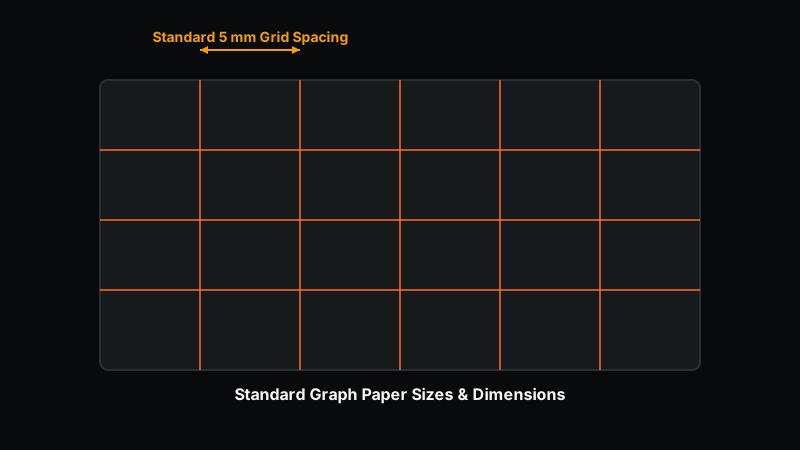
When selecting graph paper for academic assignments, engineering schematics, or architectural plans, two distinct factors determine suitability: physical sheet dimensions and internal grid cell spacing.
Using the wrong grid size can make equations illegible, crowd geometric figures, or cause miscounted data points.
This guide provides a comprehensive breakdown of standard physical page dimensions (A4, US Letter, A3) alongside metric and imperial grid spacing standards, helping you choose the exact graph paper format for your work.
Key Takeaways & Quick Overview
- Global Standard (ISO A4): Measures 210 × 297 mm (8.27 × 11.69 in) with 5 mm grid spacing. Default choice worldwide outside North America.
- North American Standard (US Letter): Measures 215.9 × 279.4 mm (8.5 × 11.0 in) with 1/4-inch (4x4) grid spacing.
- Metric Spacing: 1 mm (fine millimetric), 5 mm (standard quadrille), and 10 mm (large centimetric).
- Imperial Spacing: 1/4 in (4x4 quad), 1/5 in (5x5 engineering pad), and 1/10 in (10x10 technical drafting).
Table of Contents
- Physical Page Sizes: A4 vs. US Letter vs. A3 vs. Legal
- Grid Cell Spacing Standards: Metric vs. Imperial
- Visual Hierarchy: Major vs. Minor Grid Lines and Colors
- Subject Selection Matrix: Choosing the Right Scale
- Digital Grid Customization Advantages
- Frequently Asked Questions
1. Physical Page Sizes: A4 vs. US Letter vs. A3 vs. Legal
Physical graph paper is printed on standardized paper sizes defined by international (ISO) and national (ANSI) standards bodies.
+-----------------------------------------------------------------------+
|  Paper Format Physical Dimensions Comparison                          |
|                                                                       |
|  A3 Format:     420 x 297 mm  (16.54 x 11.69 inches)                  |
|  A4 Format:     210 x 297 mm  ( 8.27 x 11.69 inches)                  |
|  US Letter:     215.9 x 279.4 mm ( 8.50 x 11.00 inches)                 |
|  US Legal:      215.9 x 355.6 mm ( 8.50 x 14.00 inches)                 |
+-----------------------------------------------------------------------+
ISO A4 Format (210 × 297 mm / 8.27 × 11.69 in)
ISO A4 is the international standard paper size used across Europe, Asia, Latin America, Africa, and Oceania. Featuring an aspect ratio of 1 : √2 (approx. 1 : 1.4142), A4 is the default choice for binders, lab reports, and printable vector PDFs. Read our dedicated guide on A4 graph paper dimensions.
US Letter Format (215.9 × 279.4 mm / 8.5 × 11.0 in)
The standard paper format in the United States, Canada, and Mexico. While slightly wider and shorter than A4, it offers nearly identical printable surface area for school and office tasks.
ISO A3 Format (420 × 297 mm / 16.54 × 11.69 in)
A3 paper is twice the size of A4. It is widely used by structural engineers, architects, and electrical designers for large schematic blueprints, site maps, and floor plans.
2. Grid Cell Spacing Standards: Metric vs. Imperial
Grid cell spacing defines the distance between adjacent horizontal and vertical grid lines.
| Grid Classification | Cell Spacing | Measurement System | Best Applications |
|---|---|---|---|
| 1 mm Fine Grid | 1.0 mm / 0.1 cm | Metric Millimetric | Physics laboratory data, calculus, optics graphs |
| 5 mm Standard Grid | 5.0 mm / 0.5 cm | Metric Quadrille | High school math, geometry, general notes |
| 10 mm Large Grid | 10.0 mm / 1.0 cm | Metric Centimetric | Primary school arithmetic, bar charts |
| 1/4 Inch (4x4) | 0.25 in (6.35 mm) | Imperial Quad | Standard North American school math |
| 1/5 Inch (5x5) | 0.20 in (5.08 mm) | Imperial Engineering | Engineering computation pads |
| 1/10 Inch (10x10) | 0.10 in (2.54 mm) | Imperial Fine | Circuit schematics, technical drafting |
3. Visual Hierarchy: Major vs. Minor Grid Lines and Colors
Quality graph paper uses two distinct line weights and specialized color tones to create visual organization:
- Minor Grid Lines: Fine, light lines that define individual cell boundaries (e.g., every 5 mm).
- Major Grid Lines: Thick, prominent lines placed at multi-cell intervals (e.g., every 5th or 10th minor line).
- Grid Color Tones: Standard graph paper is printed in light non-repro blue (
#93C5FD) or soft green tint. Non-repro blue lines do not show up when photocopied, leaving clean black pencil drawings on white paper.
Visual Hierarchy Example (5 mm grid with 5x major interval):
|----|----|----|----|====|----|----|----|----|====|
  1    2    3    4    5 cm  6    7    8    9   10 cm
Without major grid lines, counting 45 grid units across a page causes eye strain and calculation errors. Major lines create visual anchors, allowing users to scan coordinates in blocks of 5 or 10 units instantly.
4. Subject Selection Matrix: Choosing the Right Scale
| Subject / Task | Recommended Page Size | Grid Spacing | Major Accent Interval |
|---|---|---|---|
| Middle & High School Math | A4 or US Letter | 5 mm or 1/4-inch | Every 5th cell (25 mm / 1 inch) |
| Physics & Calculus Labs | A4 or US Letter | 1 mm Millimetric | Every 5mm (minor) & 10mm (major) |
| Elementary Primary Math | A4 or US Letter | 10 mm (1 cm) | Every 5th cell (50 mm) |
| Engineering Schematics | A3 or A4 Format | 5 mm or 5x5 Imperial | Every 5th cell |
| Isometric 3D Sketches | A4 Format | 60° Triangular Grid | Every 5th cell |
To learn how to print your selected grid size without scaling errors, read our tutorial on how to print graph paper at home.
Dynamic Grid Scaling
Need a specific grid size for your current assignment?
Switch between 5 mm, 10 mm, or custom pixel grid sizes instantly in Virtual Grid Paper.
5. Digital Grid Customization Advantages
Traditional paper notebooks restrict you to a single grid size per physical book. In contrast, using a digital graph paper platform allows you to adjust grid dimensions dynamically:
- Switch between 5 mm, 10 mm, or custom pixel grid spacing in seconds.
- Enable or disable grid snapping to match your workflow.
- Toggle background grids ON or OFF when exporting presentation graphics.
- Export print-ready PDFs perfectly calibrated to A4 or Letter physical page bounds.
Frequently Asked Questions
What is the most common graph paper size?
Internationally, the most common physical format is ISO A4 (210 x 297 mm) with 5 mm grid spacing. In North America, US Letter (8.5 x 11 inches) with 1/4-inch (4x4) grid spacing is standard.
What size grid is best for high school algebra and geometry?
A 5 mm (0.5 cm) or 1/4-inch grid spacing is optimal for algebra and geometry, providing clean spacing for equations and precise coordinate point plotting.
What is a major grid interval on graph paper?
Major grid intervals are emphasized, darker grid lines appearing every 5th or 10th minor grid cell to simplify counting coordinates and scaling large diagrams.